The Dangers of Your Agency Owning Your Google Ads Account
This one I've seen end business relationships badly, not because campaigns underperformed, but because when the client wanted to leave, they discovered their entire ad history, audience lists, and conversion data were locked inside an account they didn't own and couldn't access.
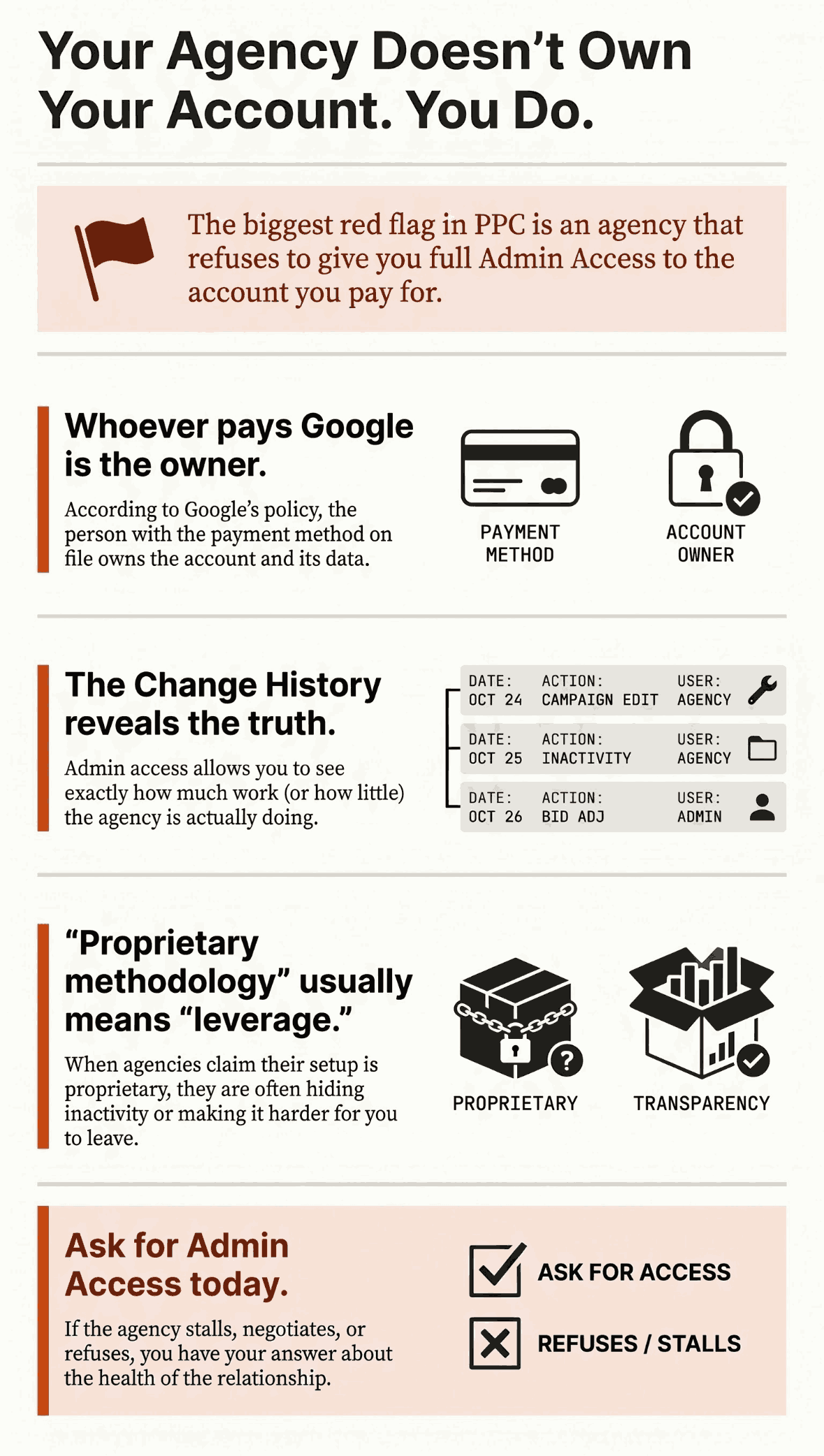

Let me start with the scenario I've walked clients through more than once. The agency relationship isn't working. The client wants to bring in a new agency, or bring the account in-house, or just have an independent auditor look at it. They go to log in to Google Ads. They don't have access. They ask the agency for access. The agency stalls, negotiates, or simply refuses.
Everything built in that account over three years (the audience lists, the negative keyword lists, the conversion history, the optimization signals baked into smart bidding) is behind a door the client doesn't have the key to. The agency knows this. In some cases, it was the plan from the start.
This is not a niche scenario. It happens regularly. And it is entirely preventable.
What normal account ownership looks like
Your company should have admin access to every ad platform where you are spending money. Not read-only. Not "we'll send you a weekly report." Admin.
Admin access means you can see:
- Billing information: the card on file, the invoice history, what Google actually charged you and when
- All users with access: who has access to the account, at what permission level, and when they were added
- The change history: every single action taken in the account, by whom, with a timestamp. Every bid change, every ad edit, every budget adjustment, every audience added or removed
- Alerts and notifications: if Google flags a payment issue, a policy violation, or a significant performance change, those come to the account owner
To be clear about what admin access does not mean: you don't need to know how to run the account. You don't need to log in daily, weekly, or monthly. You don't need to understand the interface. Accepting admin access takes three clicks and an email confirmation. It is the difference between being a partner in the relationship and being a passenger.
Who actually owns the account
According to Google's own policies: whoever has their payment method on file is the account's rightful owner. That is you. You are paying for the ads. The account exists to serve your business. Your agency manages it. They do not own it.
These are different things and the distinction matters enormously when it's time to change agencies, bring the work in-house, or resolve a dispute.
The red flags
Being denied admin access by your agency is, in my view, the single biggest red flag in this entire site's library. Bigger than bad campaigns, bigger than vanity metrics, bigger than overspending. Bad campaigns can be fixed. A locked account can cost you years of data and months of rebuild time when the relationship ends.
Here are the reasons I've actually heard, and what they mean in plain English:
"This is proprietary in how we have your account set up." Translation: we don't want you to see how the sausage is made. Specifically, we don't want an auditor to come in and note that the account structure is mediocre, the negative keyword list has 12 entries, and the last meaningful change was six weeks ago.
"We need to protect our methodology." Translation: our leverage in this relationship is that you need us to access your own account. Admin access removes that leverage.
"Read-only access is industry standard." Translation: some agencies do this, which makes it sound normal. It is not normal. It is a control mechanism that serves the agency, not the client.
"Adding more admins creates security risks." Translation: this is technically true and practically irrelevant. Your company email address with two-factor authentication is not a security risk to your own account.
What they actually don't want you to see
The change history.
If your agency is genuinely doing the work (testing ad copy, adjusting bids, building out negative keyword lists, updating audiences, optimizing landing page assignments), the change history should be dense. Dozens of entries per week. If you get admin access and find a handful of changes per month, you now know the level of active management your retainer is buying.
This is not a theoretical concern. The change history is the most objective record of how much work has actually been done in your account. An agency that's doing the work has nothing to fear from you seeing it. An agency that isn't doing the work has every reason to keep you out.
What to do right now
Ask for it. Today. On the next call, or in an email before the next call:
"We'd like admin access to our Google Ads account. Can you send us an invite to [your company email]?"
Watch what happens. If the answer is yes and an invite arrives within the day, good. If the answer involves negotiation, explanation, delay, or refusal, that is your answer about the relationship, and it came for free.
This applies to every platform. Google Ads, Microsoft Advertising, Meta Business Manager, LinkedIn Campaign Manager, TikTok for Business: any platform where your agency manages your spend should be under an account your company controls. The pattern of an agency owning the account is the same everywhere. So is the reason.
Before your next agency relationship starts
Establish this at the contract stage, before the first campaign goes live:
"Our company will own the account. Please build the campaigns inside our Google account, or transfer admin access to us before work begins."
This is not a negotiating position. It is a baseline. An agency that objects to this at the contract stage is telling you something important before you've spent a dollar.