Why Is My Agency Overspending My Monthly Budget?
Your agency came in $4,000 over budget last month. They said it was a busy period, or Google's algorithm was aggressive. Here's what's actually going on, and what a reasonable answer looks like.
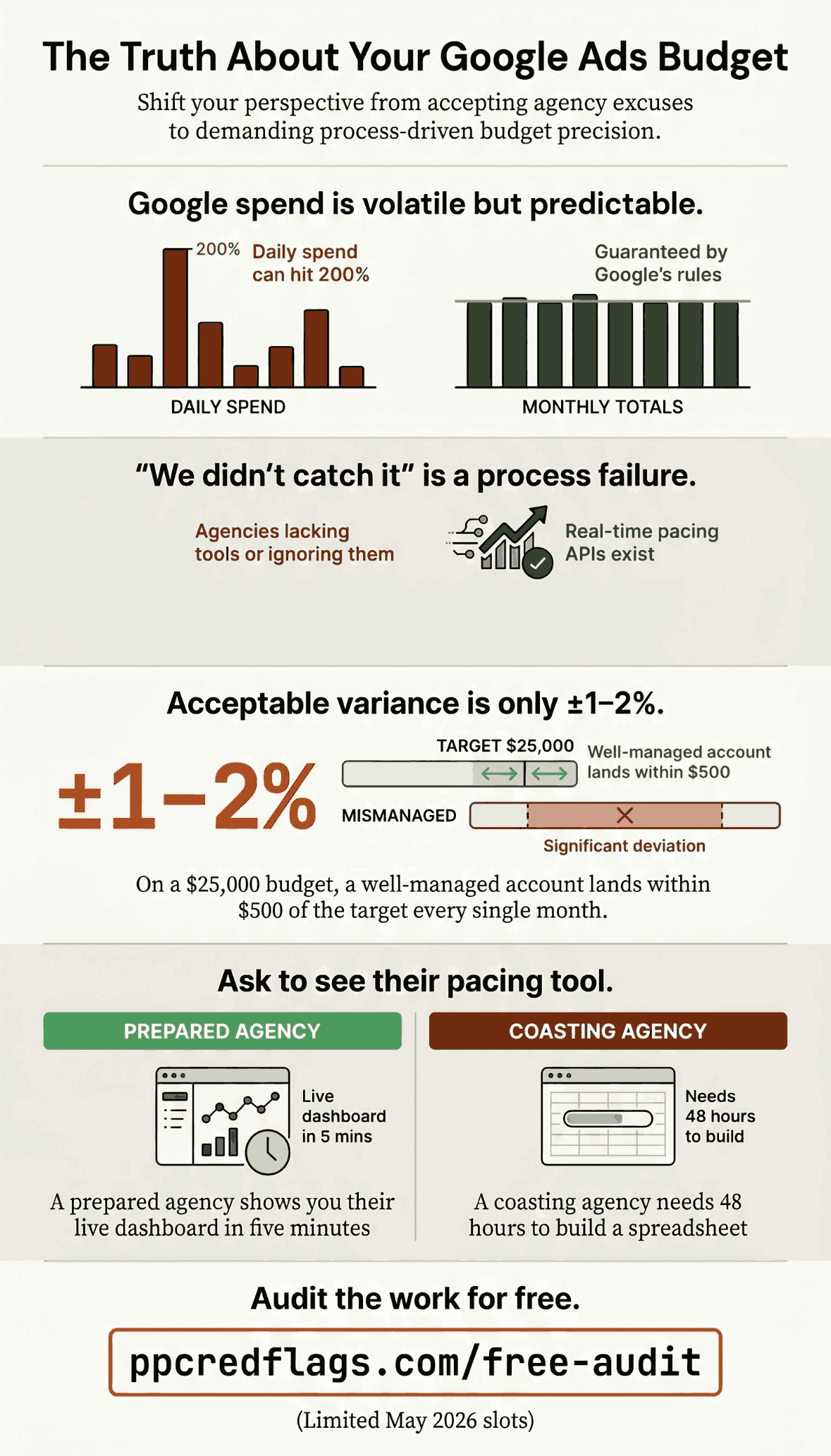

This is the question I get more than almost any other. The agency came in over budget last month, sometimes by a little, sometimes by a lot. When you asked why, they said it was a busy period, or Google's algorithm was aggressive, or the campaigns just ran hot. Let me tell you what's actually going on and where the line between understandable and unacceptable sits.
Why Google's budgeting is genuinely complicated
First, the honest version. The complexity is real, even if it doesn't excuse the outcome.
Auction pricing is per-click, not per-campaign. Every user search triggers a real-time auction. On the same keyword, you might pay $2.37 for one click and $7.88 for the very next one from a different user. Not because your agency set two prices, but because that's how Google's auction works. Your Quality Score, your competitor's bid at that exact moment, the user's device, their location, their search history, the time of day, whether they're in one of your audience lists. All of it moves the final CPC in real time. There is no fixed price for a click, ever.
Campaign budget rules are counterintuitive. Google doesn't cap each day's spend at your daily budget. It can spend up to 2× your daily budget on any given day. The rationale: high-traffic days deserve more coverage. The guarantee is that you won't pay more than your daily budget × 30.4 over a calendar month. Change a campaign's daily budget mid-month and that guarantee resets on a new basis. Change it on the 20th of the month, and the math covering the first 19 days is already locked in. Across dozens of campaigns on multiple platforms, this adds up fast.
This is not: paying Google a fixed monthly retainer that gets drawn down as ads serve. You do not pay $30,000 and watch Google tick down from that number. You pay per auction, per click, per impression: programmatically, in real time, across every campaign simultaneously.
So on the surface, landing within a few hundred dollars of a monthly budget goal genuinely does seem complicated.
The keyword there is "surface."
What complexity doesn't excuse
It's 2026. Every major ad platform has a budget pacing API. Real-time spend data is available at the campaign level, updated continuously throughout the day. The math for projecting end-of-month spend from current daily pacing is not complicated. It is multiplication and a date difference.
A good agency has automated pacing dashboards: tools that pull live spend data, project where each campaign lands by end of month, and alert the account manager when anything is trending above or below threshold. This is not exotic infrastructure. It's a spreadsheet with a few formulas, or one of dozens of third-party tools built exactly for this purpose, or a script that takes thirty minutes to write.
"We didn't catch it in time" is not a statement about Google's complexity. It is a statement about process. Either the tooling doesn't exist. Or the tooling exists but nobody's looking at it. Or the tooling is flagging it and nobody's acting on it. None of those is acceptable on any account above a few hundred dollars a month in spend.
The excuse that tends to follow ("Google's algorithm can swing quickly") is accurate and irrelevant. The algorithm swings quickly every month. A pacing system accounts for that variance. That's the point of a pacing system.
What acceptable looks like
A well-run agency lands within ±1–2% of your agreed monthly budget, every month. That means on a $25,000/month account, the bill comes in between $24,500 and $25,500. On a $100,000/month account, between $98,000 and $102,000.
This is not a technically heroic target. It's achievable because the tools exist to make it achievable. When your agency consistently misses it (in either direction, though overspend is the more common problem), the question isn't just "what happened this month?" It's "what does your pacing process actually look like, and who owns it day to day?"
If the answer involves a human manually checking spend once a week, you now know where the ceiling is. And if they can't get budgeting right (the most measurable, most automatable part of the job), the natural follow-up question is what else isn't being caught.
The question to ask
"Can you walk me through your budget pacing process and show me the tool you use to monitor it?"
A good agency produces it in the next five minutes. A bad one produces a spreadsheet in 48 hours that looks like it was assembled after you asked.